The 2026 edition of NFPA 70 changed one sentence in 690.33(C), and the change is small enough to miss on a first read. Where the 2023 edition accepted intermateability that was "described in the manufacturer's instructions," the 2026 edition requires it to be "documented by both manufacturers." For anyone who buys, specifies or installs PV connectors in a jurisdiction that has adopted NEC 2026, that shift moves the burden from one party to two, and it turns a verbal assurance into something that has to exist on paper before the connectors are mated.
The full text of the subsection is short. Understanding what it does and does not change matters more than memorising the wording.
1. The two code texts, side by side
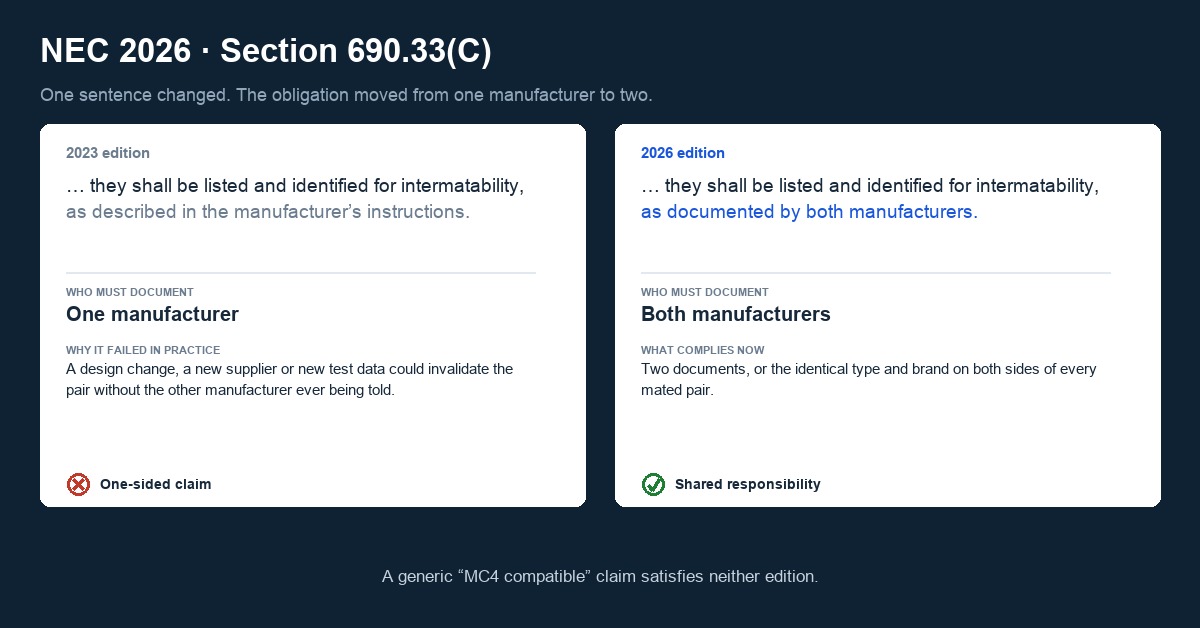
NEC 2023, 690.33(C) Type: "Where mating connectors are not of the identical type and brand, they shall be listed and identified for intermatability, as described in the manufacturer's instructions."
NEC 2026, 690.33(C) Type: "Where mating connectors are not of the identical type and brand, they shall be listed and identified for intermatability, as documented by both manufacturers."
Everything before the comma is unchanged: the connectors still have to be listed, and still have to be identified for intermatability. What changed is whose documentation counts. Under the older wording, one manufacturer's instructions could carry the claim. Under the 2026 wording, each manufacturer of the two mating halves has to have evaluated the pairing and documented it.
2. What the revision did not change
690.33(C) sits inside a section that covers more than intermateability, and the rest of it is untouched by this revision. Connectors used in PV circuits over 30 V DC still have to be of the latching or locking type, still have to be readily accessible, and still have to be listed for the purpose. Polarisation, the requirement that a connector not be interchangeable with receptacles of other systems on the premises, and the rules on opening a mated connector under load all remain as they were.
That distinction matters in the field. A mated pair that satisfies 690.33(C) on documentation still fails if the connectors are not locking, or if a latching connector of a type that can be pulled apart by hand is used on a DC source circuit. Intermateability documentation is an added condition, not a substitute for the rest of the section.
3. Why the sentence was rewritten
The technical reasoning behind the revision is documented in the code-change record: the previous approach "assumed that a single manufacturer's documentation was sufficient to confirm proper mating with the other connector from a different manufacturer, but field experience has shown that the instructions for some products do not provide the level of detail needed to ensure sufficient compatibility."
The failure mode is specific. A manufacturer qualifies its connector as a system: contact geometry, spring force, plating, housing tolerances and seal compression are all controlled to its own drawings. If that manufacturer later revises the contact design, changes a supplier or updates test data, the connector it sells under the same part number may no longer mate as it did with another brand's product — and the other manufacturer has no way of knowing that happened. Under the 2023 wording, the installer could legally mate two connectors that were no longer listed together as compatible.
A mated PV connector is a sealed contact system carrying continuous DC. Small mismatches in contact fit or seal compression raise contact resistance and admit moisture. In a string that carries current for hours at a time, that becomes heat, and heat at a contact is self-accelerating: oxidation raises resistance, resistance raises temperature, temperature accelerates oxidation. The mechanism is the same one covered in Can Poor PV Connector Quality Cause Solar Fires?, and the NEC revision is an attempt to close the documentation gap that lets mismatched pairs get installed in the first place.
4. What "listed and identified for intermatability" requires
"Intermatability" is a term that comes from UL 6703, the product standard covering connectors for use in photovoltaic systems. A listing is issued by a nationally recognised testing laboratory after evaluation against that standard. So the requirement in 690.33(C) is not satisfied by:
- a statement that a connector is "MC4 compatible" — that phrase describes a mechanical family, not a listing;
- a dimensional drawing showing that two connectors physically engage;
- a supplier's verbal assurance, or a line in a distributor's catalogue;
- matching IP ratings on two datasheets — ingress protection is evaluated with a connector mated to its own designated counterpart, and says nothing about a mixed pair.
What satisfies it is a listing record that names the specific pairing, and — from 2026 onward — documentation from both manufacturers of that pairing.
5. What the documentation has to contain
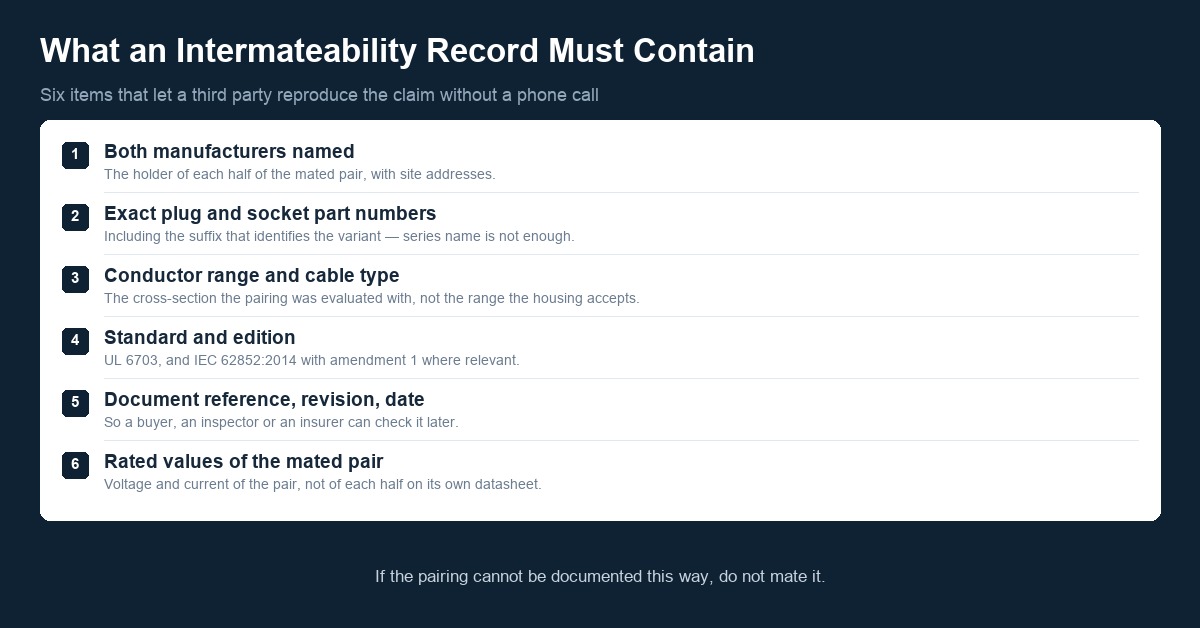
When a cross-brand pairing genuinely is listed, the paperwork should let a third party reproduce the claim without making a phone call. In practice a usable record contains:
- both manufacturers' names;
- the exact plug and socket part numbers on each side, including any suffix that identifies a variant;
- the conductor cross-section range and cable type the pairing was evaluated with;
- the applicable standard and edition (UL 6703, and where relevant IEC 62852);
- the document reference, revision and date;
- the rated voltage and current of the mated pair, not of each half separately.
A document that gives a brand and a series but not the part number is not verifiable, because manufacturers routinely run several variants under one series name with different contact plating and different temperature ratings. The revision is aimed precisely at that level of vagueness.
6. Where the rule bites hardest
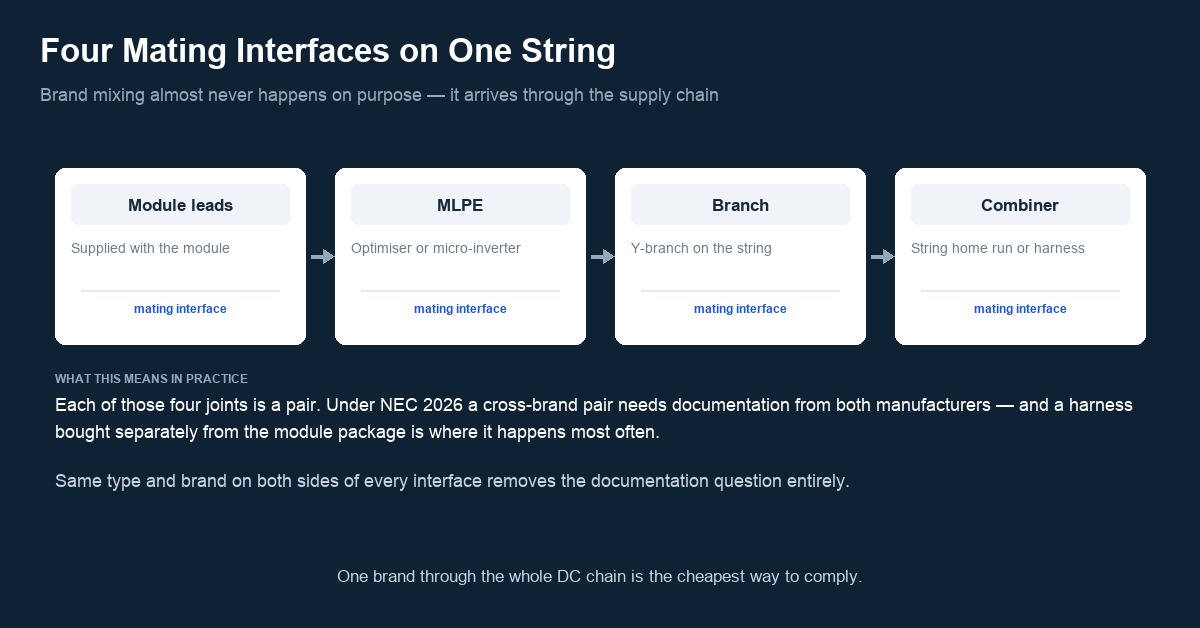
Almost no one sets out to mix connector brands. It happens through the supply chain:
- Module leads. Modules arrive with pre-installed leads and connectors from the module maker's chosen supplier. Every string extension, branch connector or harness has to mate with that specific connector.
- MLPE devices. Optimisers and microinverters carry their own leads. A string that mixes module-brand connectors with optimiser-brand connectors is a cross-brand pair.
- Combiner and harness assemblies. Pre-assembled harnesses are frequently bought separately from the module package, and a different connector brand is the most common outcome — a pattern familiar from harness installation practice.
- Expansions and repairs. An array extended three years after commissioning usually cannot get the original connector brand, or gets it under a revised part number.
Each of those is a mating interface, and each one needs the same answer. The practical consequence is that connector brand has to be decided during design, not at the material take-off stage.
7. What to write on the purchase order
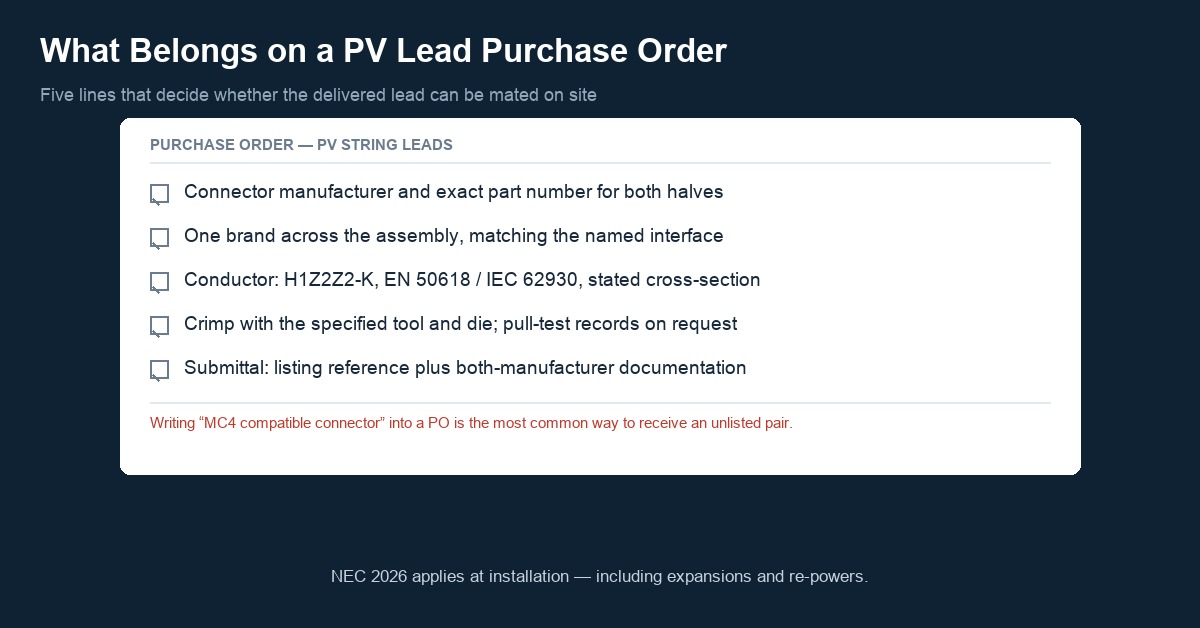
The cheapest compliance path is also the simplest: specify the identical type and brand on both sides of every mated pair. Where a PO goes out for string leads, harnesses or branch connectors, the following belongs in the line item:
- connector manufacturer and exact part number for both plug and socket;
- a statement that the assembly is to be supplied with one connector brand throughout, matching the mating interface named in the project specification;
- conductor cross-section and cable standard (for example H1Z2Z2-K to EN 50618 / IEC 62930 — see Solar Panel Cable: Why H1Z2Z2-K Is the Standard);
- requirement that crimping be done with the tooling specified by the connector manufacturer, with crimp and pull-test records available on request;
- submittal of the connector listing reference and, where the pairing is cross-brand, the intermateability documentation from both manufacturers.
Writing "MC4 compatible connector" into a PO is the single most common way to end up with an unlisted pair.
8. What an inspector is likely to ask for
Under NEC 2026, the inspector's question is no longer "are these compatible?" but "who says so, and can I see it?" A project file that closes out cleanly typically holds:
- the connector manufacturer's installation instructions for each connector used;
- the listing reference (UL file number or equivalent) for each connector;
- for any cross-brand pair, the intermateability documentation from both manufacturers;
- an as-built list mapping each mating interface to the two part numbers that meet there;
- crimp tooling records and, where a pull-test regime was specified, the results.
Note that adoption is not uniform. States and cities adopt NEC editions on their own schedules, and plenty of jurisdictions are still enforcing the 2020 or 2023 edition. Confirm which edition the authority having jurisdiction has adopted before treating this revision as binding — and note that even in a 2023 jurisdiction, 110.3(B) already requires equipment to be installed in accordance with its listing and manufacturer's instructions.
9. Existing arrays and legacy stock
The revision applies at installation, not retroactively to arrays already commissioned. But two situations deserve attention:
Expansions and re-powers. Adding strings to an existing array creates new mating interfaces. If the original connector brand is no longer available, the project is looking at either finding the documented equivalent or replacing the mating halves on the existing side — which means re-terminating the existing leads, not just buying different connectors.
Warehoused stock. Connector stock bought under a generic "MC4 compatible" description does not carry the documentation the 2026 edition asks for. That stock is still usable on the interfaces it can be documented for; it is not usable as a universal substitute. Sorting stock by part number rather than by family is the practical first step.
10. Outside NEC jurisdictions
No IEC-based installation code contains a direct equivalent of "documented by both manufacturers." IEC 62852 evaluates a connector as a system, and the direction of travel in that committee is towards greater restriction, not less: the draft second edition adds a requirement that a PV coupler must not be intermated with a standardised PV connector unless it satisfies both standards. What a European or Brazilian specifier gets from the NEC change is not a rule to follow but a signal about where the industry is moving, and a useful template for what to demand from suppliers in any market. Our overview of PV connector cross-mating covers the mechanical and certification side of the same question.
11. The practical summary
Three actions cover most of the exposure:
- Decide the connector brand at design stage and hold it across module leads, MLPE, harnesses, branch connectors and combiner inputs.
- Write exact part numbers into every PO, and require the mating interface to be named.
- Where a cross-brand pair is unavoidable, obtain both manufacturers' documentation before installation and file it with the as-built documentation — not after the inspection fails.
The cost of holding one connector brand through a project is small. The cost of re-terminating an array after a failed inspection, or of tracking down an intermittent high-resistance joint in a commissioned string, is not.
Frequently asked questions
Does NEC 2026 ban mixing connector brands?
No. The revision does not prohibit cross-brand mating; it changes who has to document it. Where mating connectors are not the identical type and brand, they must be listed and identified for intermatability as documented by both manufacturers. Because such dual-documented listings are rare in practice, the workable route is to use the same type and brand on both sides.
Is "MC4 compatible" enough to satisfy 690.33(C)?
No. "MC4 compatible" describes a mechanical family, not a listing. A listing is issued by a nationally recognised testing laboratory against UL 6703 and names a specific product. A generic compatibility claim from one manufacturer does not meet the 2026 wording, which requires documentation from both manufacturers of the mating pair.
Do the two connectors need the same IP rating as well?
Matching IP ratings do not establish intermateability. Ingress protection is assessed with a connector mated to its own designated counterpart; seal geometry, O-ring placement and compression differ between manufacturers. A mixed pair can carry identical IP ratings on its datasheets and still not seal correctly when mated.
Which NEC edition applies to my project?
Whichever edition the authority having jurisdiction has adopted. NEC editions are adopted at state and local level on different schedules, so a 2026 change may not be enforceable in a given jurisdiction yet. Confirm the adopted edition with the AHJ before treating any revision as binding.
Does this affect connectors already installed?
Code revisions apply at installation, not retroactively. The practical risk is in expansions, re-powers and repairs, where new mating interfaces are created on an existing array and the original connector brand or part number may no longer be available.
References
- NFPA 70, National Electrical Code, 2023 and 2026 editions, 690.33(C) Type — nfpa.org (free online access to the current edition)
- UL 6703, Connectors for Use in Photovoltaic Systems — UL Solutions product standard defining intermateability evaluation
- Code change record and subject-matter commentary on the 2026 revision to 690.33(C), Electrical License Renewal continuing-education material, 2026
- IEC 62852 ED2, PV coupler for DC-application in photovoltaic systems — Safety requirements and tests; CDV circulated 2026-10-16 (IEC TC 82 document 82/2690/CDV)
- Treasol, PV Connector Compatibility: Can Brands Be Mixed?
- Treasol, Can Poor PV Connector Quality Cause Solar Fires?
Reviewed by the Treasun New Energy technical team. Product data in this article reflects published ratings at the time of writing; always confirm against the current datasheet for the exact part number.