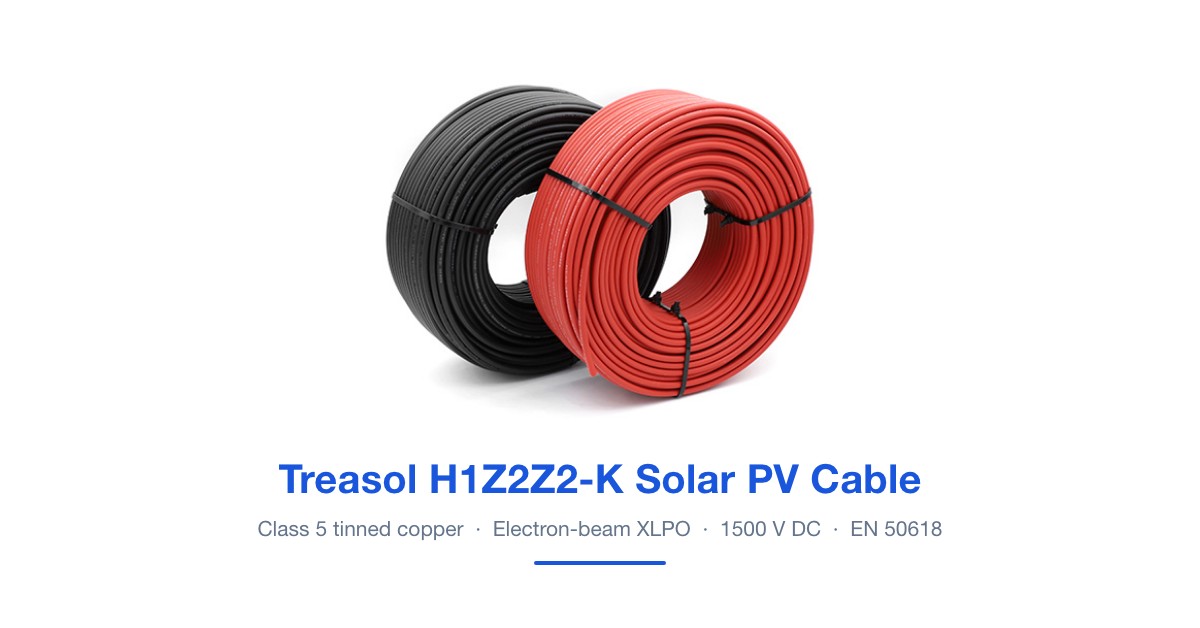
A PV array's cable is usually the last thing specified and the first thing to cause trouble. The DC string run sits in full sun at up to 1500 V for 25 years, and a wrong cross-section or a non-PV compound shows up years later as voltage-drop losses, cracked insulation or an arc behind the panels. On the DC side the specification has largely converged on one cable type: H1Z2Z2-K, built to EN 50618 and the equivalent IEC standard IEC 62930.
The designation carries most of the specification. Once you can read it, the compound, conductor and voltage class follow, and what remains is sizing the cross-section against string current and voltage drop.
1. What the DC side of a PV array needs
Four conductor types appear around a PV plant, and mixing them up is a routine sourcing mistake:
- PV string (DC) cable — module to string, combiner and inverter on the DC side. This is the H1Z2Z2-K cable and the subject of this article.
- AC cable — inverter output to transformer or grid. Larger conductors, often aluminium in utility feeders.
- Grounding and earthing cable — frame and enclosure bonding to NEC 690 / 250. Fault-rated copper, or aluminium where listed.
- Communication and sensor cable — separate, low voltage, no string current.
Older buyer guides still quote 600 V as a PV cable rating. That figure belongs to legacy 600 V systems; a new design runs at 1000 V DC (residential and C&I) or 1500 V DC (utility-scale). A 600 V cable has no place in either.
2. What H1Z2Z2-K actually means
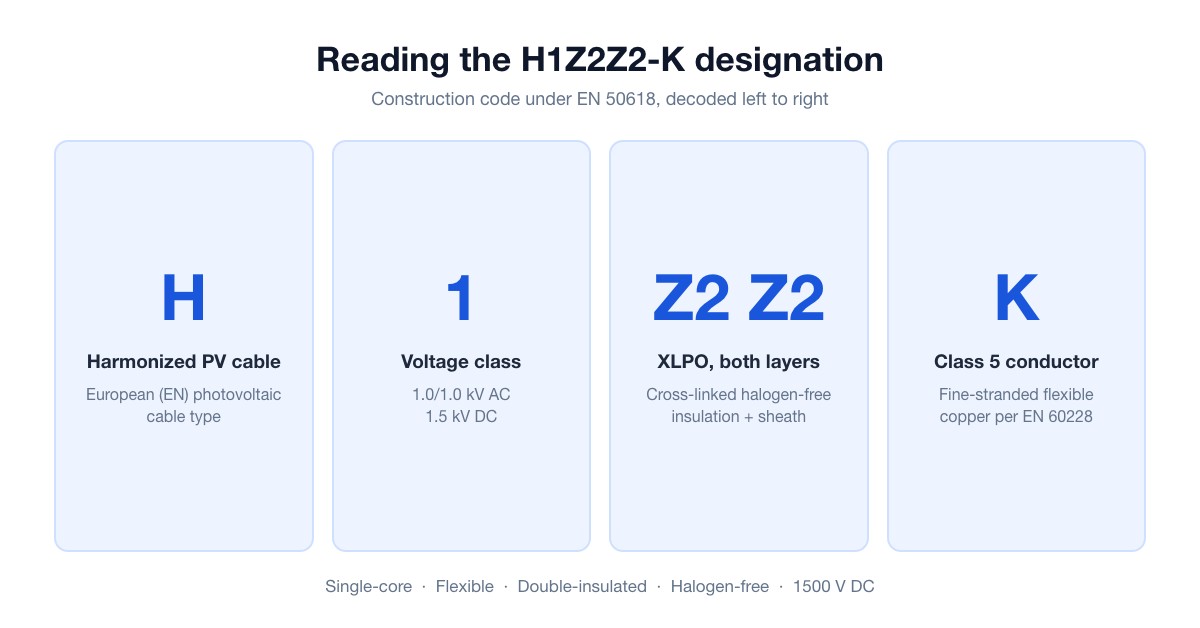
The designation is a construction code under EN 50618, read from left to right:
| Code | Meaning |
|---|---|
| H | Harmonized (EN) photovoltaic cable |
| 1 | Voltage class — 1.0/1.0 kV AC; 1.5 kV DC |
| Z2 Z2 | Insulation and sheath both cross-linked halogen-free polyolefin (XLPO) |
| K | Flexible Class 5 conductor per EN 60228 |
The result is a single-core, flexible, double-insulated, halogen-free cable rated 1500 V DC. TÜV PV1-F is the older TÜV designation for the same XLPO family and is still quoted in tenders; H1Z2Z2-K is the current EN-harmonized equivalent. IEC 62930 is the international version of EN 50618, used where the IEC reference governs instead of the European one.
3. Why the compound matters: XLPO, not PVC
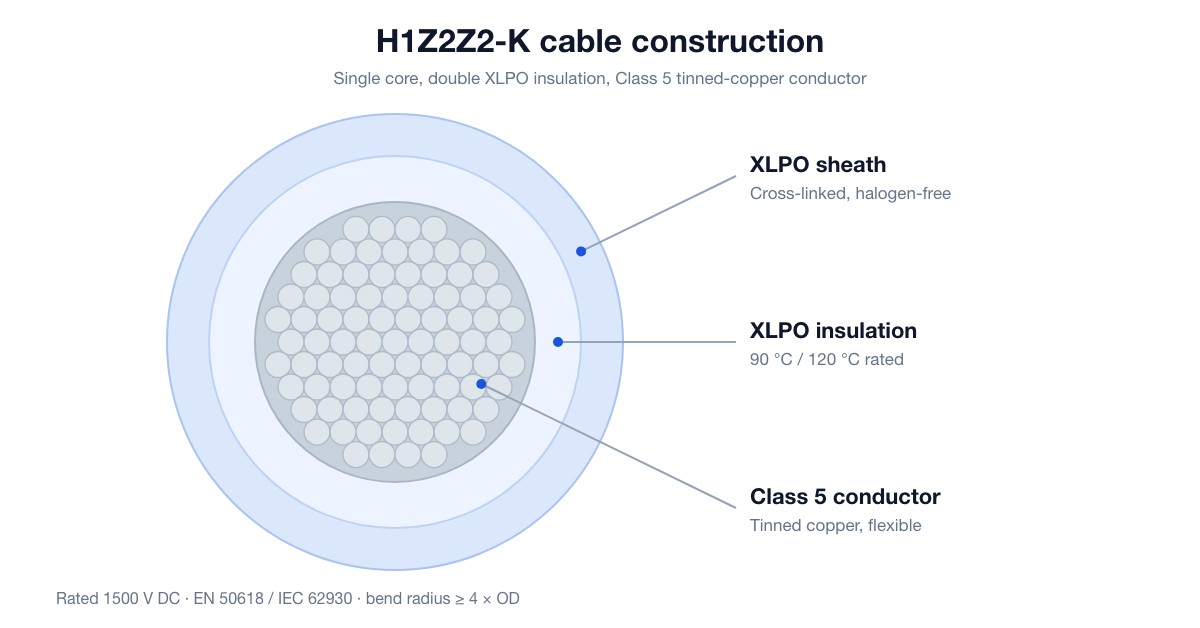
The insulation and sheath compound is what separates a PV cable from ordinary building wire. H1Z2Z2-K uses electron-beam cross-linked polyolefin. Cross-linking turns the polymer from a thermoplastic, which softens as it heats, into a thermoset network that holds its shape. The practical differences:
- Thermal class — 90 °C continuous conductor temperature, 120 °C for up to 20,000 h in overload, and 250 °C for 5 s under short circuit. PVC cannot approach this.
- UV and ozone — a cross-linked polyolefin does not embrittle or craze after years of sun and ozone; PVC and untreated PE do.
- Halogen-free and low-smoke — to EN 60754-1/-2 (no acid gas) and IEC 61034 (light transmittance above 70 %). In an enclosed or rooftop fire, this decides whether the escape route stays usable.
- Flame behaviour — self-extinguishing and non-propagating to EN 60332-1-2.
A general-purpose wire rated for indoor use will crack and leak within a few seasons outdoors. That is the reason PV cable is a separate product, not a marketing preference.
4. The conductor: Class 5 tinned copper
EN 60228 Class 5 is a fine-stranded flexible conductor, and it is specified for PV for two reasons:
- Flexibility — fine strands route around module frames and into junction boxes and connector glands without kinking.
- Tinning — the tin coating slows the surface corrosion that raises contact resistance over a 25-year service life, and matters most in humid, coastal and polluted sites.
Tinned copper is the standard for DC string wiring. Aluminium appears in large utility AC collectors, but not in module-to-inverter string runs, where creep and termination reliability make it a poor fit.
5. Electrical and thermal ratings
| Parameter | H1Z2Z2-K (EN 50618 / IEC 62930) |
|---|---|
| Rated voltage | 1.0/1.0 kV AC; 1.5 kV DC |
| Max. system voltage | 1.5 kV DC (1500 V DC strings) |
| Test (hi-pot) voltage | 6.5 kV AC, 5 min |
| Service temperature | −40 °C to +90 °C |
| Conductor, continuous | 90 °C |
| Conductor, overload | 120 °C for 20,000 h |
| Short-circuit, 5 s | 250 °C |
| Bending radius | ≥ 4 × outer diameter, fixed installation |
| Design life | ≥ 25 years at rated conditions |
| Cross-sections | 2.5 / 4 / 6 / 10 / 16 mm² |
| Colours | Red (positive) / black (negative) |
6. Sizing the cable
EN 50618 gives the cable's own current capacity in free air at 30 °C ambient with a 90 °C conductor:
| Cross-section | ≈ AWG | Free-air ampacity* |
|---|---|---|
| 2.5 mm² | 14 AWG | ~41 A |
| 4 mm² | 12 AWG | ~55 A |
| 6 mm² | 10 AWG | ~70 A |
| 10 mm² | 8 AWG | ~98 A |
| 16 mm² | 6 AWG | ~132 A |
*Indicative free-air values. Bundled, conduit and high-ambient installations derate these — roughly ×0.91 at 40 °C and ×0.82 at 50 °C — so installed figures are lower; the PV DC cable sizing guide lists practical values by cross-section.
On a real string the current is set by the module, not the cable. Three checks decide the cross-section:
- Current — design for Isc × 1.25, the factor that covers irradiance and reflection gains above STC.
- Voltage drop — keep the DC-side drop at or below 2 %, with 3 % as the absolute limit. Drop grows with run length and falls with cross-section; long home runs to a 1500 V combiner often step up to 6 or 10 mm².
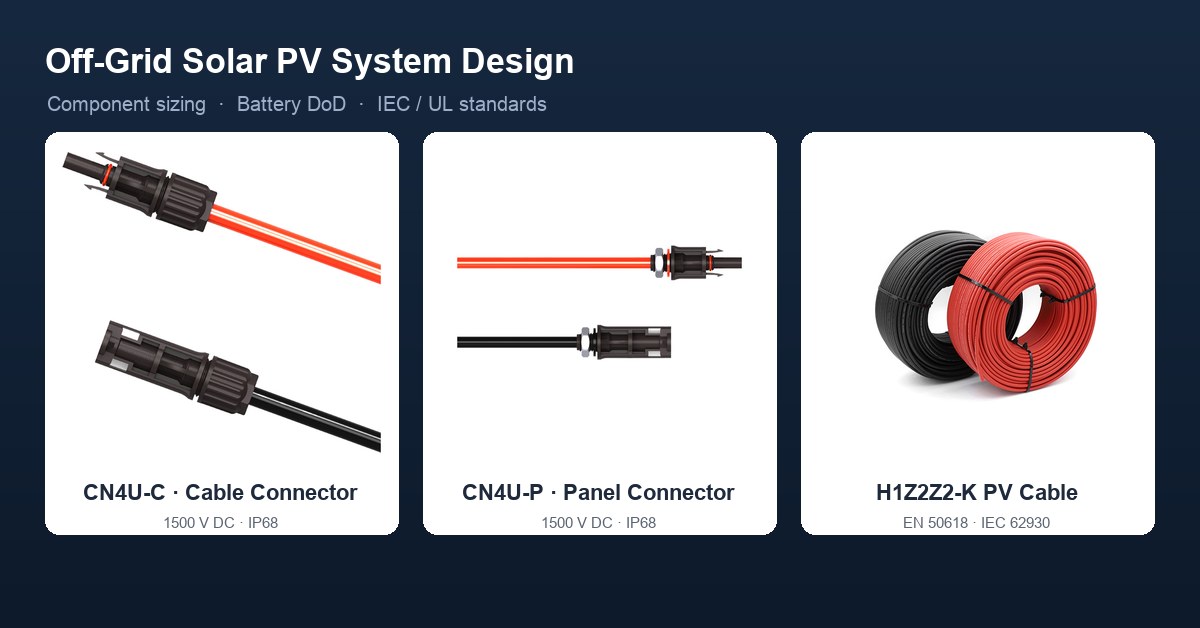
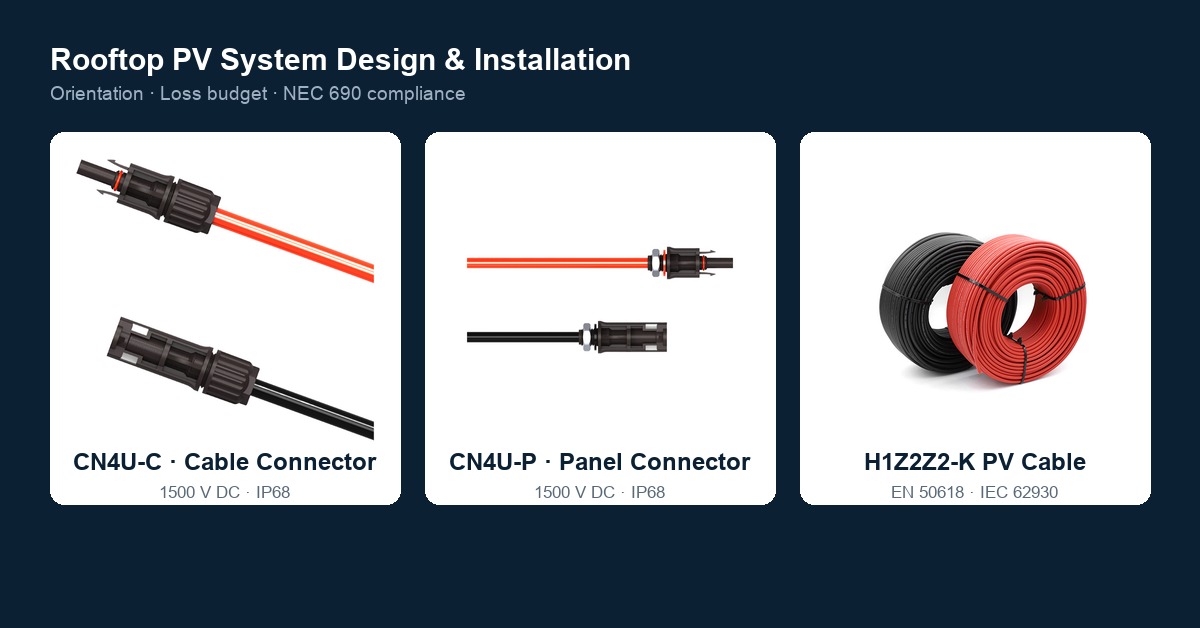
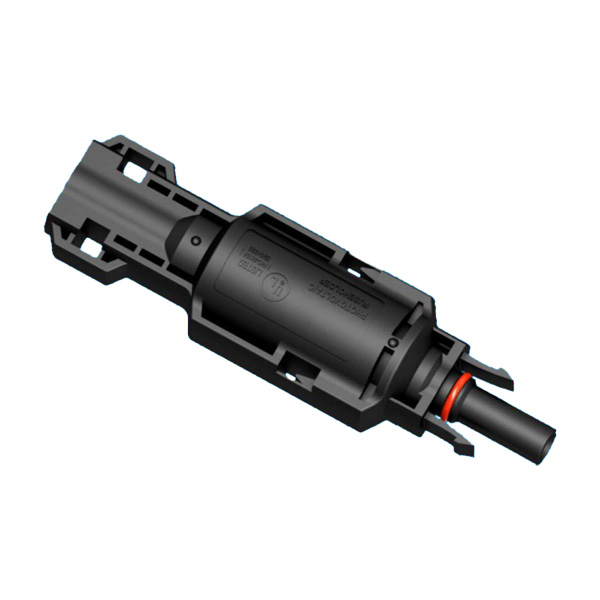
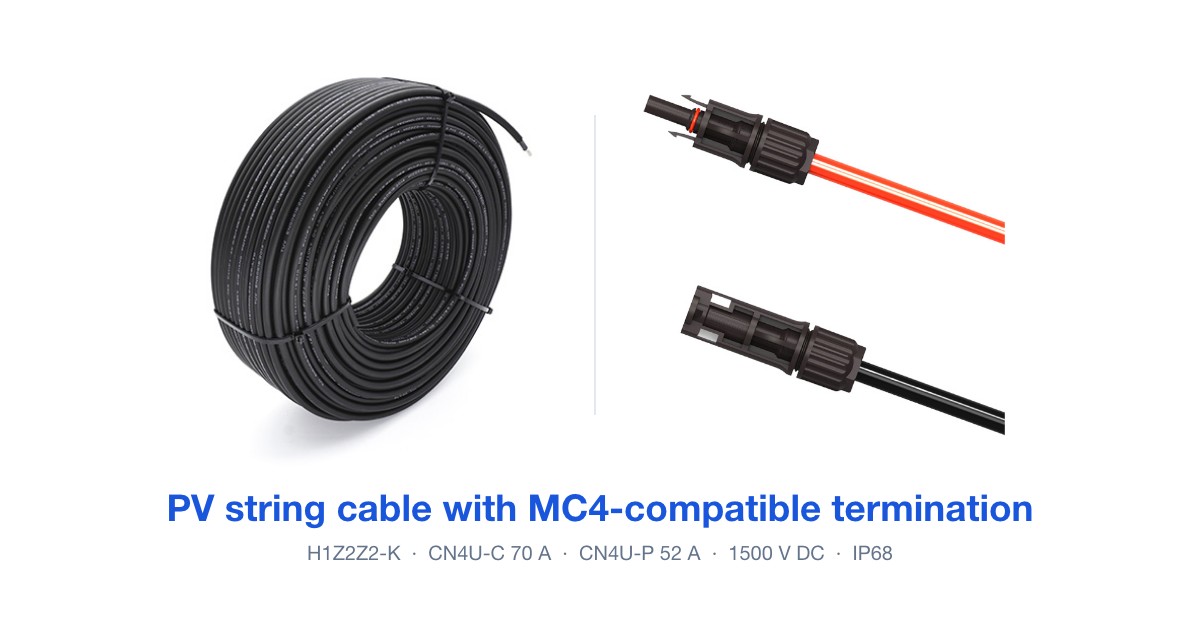
- Termination — the connector sets a ceiling too. Conventional MC4-style connectors are commonly rated around 30 A; the Treasol CN4U-C is rated 70 A and the CN4U-P 52 A, so the termination does not have to be the bottleneck on a 4 or 6 mm² string.
Voltage drop follows Vd % ≈ (2 × I × L × R) / (V_system × 1000) × 100, where I is string current in amps, L is one-way run length in metres, R is conductor resistance in Ω/km (about 5.09 for 4 mm² and 3.39 for 6 mm²), and V_system is the DC system voltage. The factor of two accounts for the out-and-back path.
7. Standards and test reports
A compliant H1Z2Z2-K cable is verified against a defined set:
- EN 50618 / IEC 62930 — PV cable construction, dimensions and type tests.
- EN 60228 — conductor class (Class 5 tinned copper).
- EN 60332-1-2 — flame non-propagation, single cable.
- EN 60754-1 / -2 — halogen-free, no acid gas.
- IEC 61034 — low smoke density.
- EN 60811-2-1 — ozone resistance.
- TÜV 2 PfG 1169 (PV1-F) — TÜV component specification.
- RoHS / REACH — substance compliance.
A "CE" mark or a "solar cable" label on its own proves nothing. The document to ask for is the type-test report issued against EN 50618 / IEC 62930 by an accredited laboratory.
8. How to specify the right cable
- Voltage class — confirm 1000 V or 1500 V DC to match the string; H1Z2Z2-K is rated 1.5 kV DC, covering both.
- Cross-section — from Isc × 1.25 and the voltage-drop target. 4 mm² is typical for residential strings, 6 mm² for longer runs, 10 mm² for combiner-to-inverter trunks.
- Environment — coastal, industrial and enclosed sites should require the halogen-free, low-smoke, chemical-resistant compound explicitly.
- Polarity — red positive, black negative, consistently across the array. A reversed string is a wiring fault, and consistent colours are what make it visible.
- Certification — require the EN 50618 / IEC 62930 type-test report, plus TÜV or UL where the market requires it.
9. Treasol H1Z2Z2-K solar cable
Treasol's H1Z2Z2-K solar PV cable is built to EN 50618 with a Class 5 tinned-copper conductor and electron-beam cross-linked XLPO insulation and sheath, rated 1500 V DC with a 25-year design life. It is stocked from 2.5 to 16 mm² in red and black within the PV cable category, and pairs with the CN4U-C cable connector (70 A) and CN4U-P panel connector (52 A), both rated 1500 V, IP68 and MC4-compatible. For termination and crimping detail, see the MC4-compatible connector guide and the PV connector manufacturing process.
10. Frequently Asked Questions
What is H1Z2Z2-K solar cable?
It is the EN 50618 photovoltaic cable: a single-core, flexible Class 5 tinned-copper conductor with cross-linked halogen-free (XLPO) insulation and sheath, rated 1500 V DC with a 25-year design life. IEC 62930 is the international equivalent, and TÜV PV1-F is the older designation for the same XLPO family.
Can I use normal electrical wire for solar panels?
No. Standard building wire is not rated for continuous outdoor UV, 1000–1500 V DC, or the −40 to +90 °C service range, and is usually PVC rather than halogen-free XLPO. Use a PV-rated cable such as H1Z2Z2-K.
What size PV cable do I need?
Start from the module short-circuit current times 1.25, then check that DC voltage drop stays at or below 2 %. Residential strings are commonly 4 mm², stepping to 6 mm² for longer runs and 10 mm² for combiner-to-inverter trunks. The connector also sets a limit, although higher-rated parts such as the CN4U-C (70 A) lift that ceiling.
What is the difference between H1Z2Z2-K and PV1-F?
Both describe the same XLPO photovoltaic cable family. PV1-F is the older TÜV designation; H1Z2Z2-K is the current EN-harmonized designation under EN 50618. Specifying H1Z2Z2-K, with IEC 62930 equivalence, is the version most international tenders now recognize.
Is aluminium PV cable acceptable?
Not for DC string wiring. Tinned copper is standard for module-to-inverter DC runs because of termination reliability and creep behaviour. Aluminium is reserved for large utility-scale AC collectors, not the PV string cable.
How long do solar cables last?
A correctly specified and installed H1Z2Z2-K cable has a minimum design life of 25 years under EN 50618 rated conditions, which matches typical PV plant financing horizons.
11. Conclusion
For the DC side of a solar array, the cable choice comes down to one type: H1Z2Z2-K to EN 50618 / IEC 62930 — Class 5 tinned copper, electron-beam XLPO, halogen-free and low-smoke, rated 1500 V DC for 25 years outdoors. Size it from Isc × 1.25 against a voltage-drop budget of 2 %, demand the accredited type-test report rather than a logo, and keep the DC path on one certified connector family from module to inverter.
Published by Dongguan Treasun New Energy Technology Co., Ltd, manufacturer of MC4-compatible solar PV connectors, junction boxes and H1Z2Z2-K photovoltaic DC cables certified to TÜV, UL, CE and RoHS.
References
- EN 50618:2014 — Photovoltaic cables (H1Z2Z2-K construction and tests).
- IEC 62930 — Photovoltaic systems — Cables for power chain, IEC equivalent of EN 50618.
- IEC 60228 — Conductors of insulated cables (Class 5 flexible conductor).
- IEC 60332-1-2 — Flame non-propagation, single cable.
- IEC 60754-1 / -2 — Halogen-free (no acid gas emission).
- IEC 61034 — Smoke density (light attenuation).
- EN 50396 / EN 50618 weathering — Ozone and UV resistance.
- TÜV 2 PfG 1169 (PV1-F) — TÜV component specification for PV cable.
- NFPA 70 — National Electrical Code, Articles 690 (PV systems) and 250 (grounding).
- RoHS / REACH — Substance compliance.