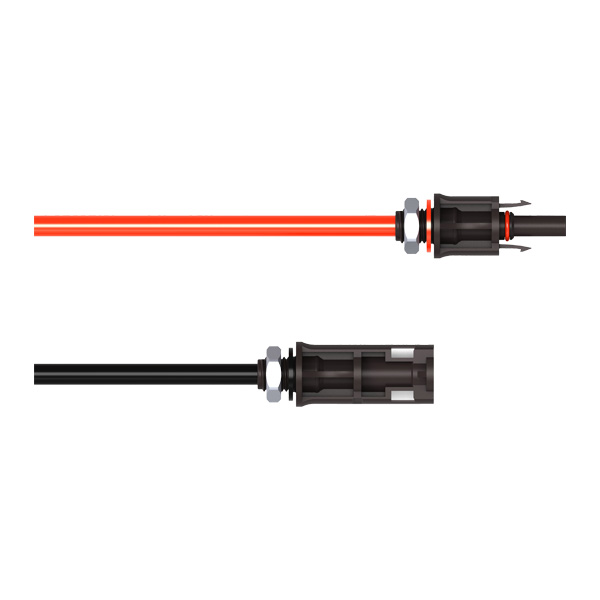
CN4U-P Solar Panel Connector
Solar Panel connectorCN4U-P is a high-performance solar panel connector designed for reliable photovoltaic (PV) module co...
View Details
Last updated: October 2026
Solar panel connectors that mount directly on photovoltaic module frames, providing sealed DC output connections from solar panels to system cabling.
The solar panel connector is the half that leaves the module: it terminates the short factory lead bonded to the junction box and provides the sealed DC output the installer plugs into. Because it stays with the panel for its service life, it has to survive the full module warranty period without the seal hardening or the contact oxidising.
CN4U-P uses the same PPE/PA66 housing, tin-plated copper contact and double-fixed retention as the cable side, rated 1500 V DC and 52 A with IP68 protection in the mated condition and contact resistance below 0.5 mΩ. It is supplied with the panel lead or as a replacement half where a module lead has been damaged in handling.
Showing 1 product in this category
| Model | Rated voltage | Rated current | Protection | Contact resistance | Conductor size |
|---|---|---|---|---|---|
| CN4U-P Solar Panel Connector | 1500 V (TUV) 1500 V (UL) | 52 A Max | IP68 | <0.5 mΩ | — |
Values are the mated-pair ratings from our published datasheets. Where a field is blank, that variant does not specify it — ask us and we will confirm against the drawing for your configuration.
Yes, provided enough lead length remains to re-terminate with a proper crimp. Cut back to undamaged conductor, strip to the specified length, and crimp a new contact with the matched die. Do not splice in a short extension — a splice inside the DC lead is a future failure point and is not covered by the connector rating.
Both are rated 1500 V DC, but the current rating differs: CN4U-P is 52 A and CN4U-C is 70 A. The applicable limit for an installation is the lower of the two mated halves, so a pair is limited by the panel side.
Male and female halves are ordered separately and used as a pair. Most installations need equal quantities of each; if you are terminating a new run rather than replacing a damaged lead, order the module-side and cable-side halves together.