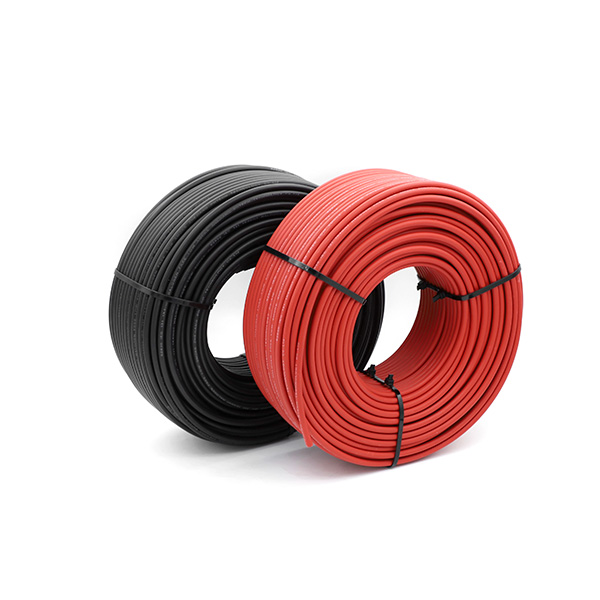
Solar PV Cable (H1Z2Z2-K)
Solar PV CableSolar PV Cable (H1Z2Z2-K)|1800V Lifespan & Warranty: 25 Years General Parameter: 2.5-35mm²
View Details
Last updated: October 2026
Solar PV cable is made specifically for photovoltaic module systems and their DC circuits. Weather, high temperature and abrasion resistance give it a long service life and consistent conductive performance outdoors, while halogen-free cross-linked XLPE/XLPO insulation and sheathing add UV, flame and corrosion resistance. Conductors are usually copper or aluminium; Treasol supplies the tinned-copper H1Z2Z2-K (EN 50618) and PV1-F (TÜV 2 PfG 1169) in 2.5 to 16 mm², rated -40 °C to +90 °C.
PV cable is the single-conductor DC cable that runs from the module leads to the combiner and on to the inverter. It is not general-purpose cable: the insulation system has to hold up under continuous UV, ozone, and the wide thermal cycling of an outdoor array, and the conductor has to stay flexible enough to route around a rack without cracking.
H1Z2Z2-K to EN 50618 is the cross-linked halogen-free type, rated 1.0/1.0 kV AC and 1.5 kV DC, with tinned copper conductor to IEC 60228 class 5 and a -40 °C to +90 °C service range. Treasol supplies it from 2.5 to 16 mm², with XLPO insulation and sheath for UV, flame and corrosion resistance.
Showing 1 product in this category
| Model | Rated voltage | Rated current | Protection | Contact resistance | Conductor size |
|---|---|---|---|---|---|
| Solar PV Cable (H1Z2Z2-K) | 1.0/1.0 kV AC, 1.5 kV DC | — | — | — | — |
Values are the mated-pair ratings from our published datasheets. Where a field is blank, that variant does not specify it — ask us and we will confirm against the drawing for your configuration.
They are two different type designations under two different standards. H1Z2Z2-K is defined by EN 50618, rated 1.0/1.0 kV AC and 1.5/1.5 kV DC. PV1-F is a TÜV 2 PfG 1169 designation with its own rating — commonly quoted at 1.8 kV DC. They are not interchangeable designations for the same cable, and the voltage rating follows the standard, not the trade name.
Tinning protects the conductor strands from oxidation, which matters at the crimp interface and anywhere moisture reaches the conductor. On a rooftop array that runs for 25 years, an oxidised strand bundle raises joint resistance over time.
Size for both ampacity and voltage drop. Ampacity sets the minimum: check the derating for bundled routing and for the highest ambient the cable will see, not the nameplate rating. Voltage drop then usually pushes the size up on long runs — keep the round-trip drop within the design limit for the string.