A solar connector's datasheet promises a contact resistance below 0.5 mΩ. Whether the finished connection actually delivers that number is decided on a rooftop, in a single motion: the crimp. Field failures in PV connectors can stem from several causes — incorrect crimping, incompatible mating pairs, damaged seals, unsuitable cable or contact combinations, material degradation, assembly errors, and manufacturing defects — and the crimp is one of the most common.
This guide covers the four operations that turn a connector and a cable into a reliable DC link — crimping, stripping, opening, and sealing — and the Treasol tool that does each one. Because tool datasheets can drift, every cross-section and rating below is derived from the connectors and cables the tools serve, not from tool specifications.
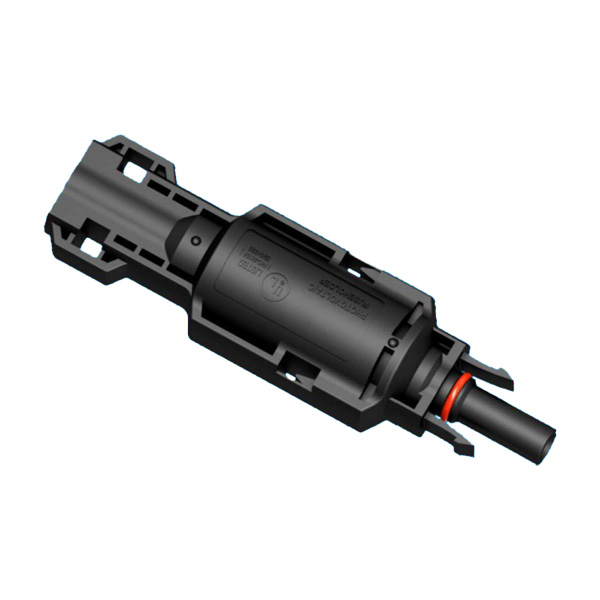
The crimp, not the connector, is where connections fail
A crimp is a cold weld. The tool deforms the terminal's barrel around the cable's copper strands so tightly that the strands and the barrel become one metal-to-metal joint, gas-tight enough to keep oxygen and moisture out. Done correctly, the joint's resistance is a small fraction of the connector's rated <0.5 mΩ contact resistance and it stays that way for the life of the module.
Done incorrectly, the same motion creates a series resistor. A loose crimp, a partially cut strand, or a barrel crimped onto the insulation instead of the copper raises the joint resistance. Under the DC current of a PV string, that resistance becomes heat — I²R — and heat is what degrades the housing, accelerates corrosion, and eventually turns a good connector into a fire risk. This is why the crimp, and the tool that makes it, deserve as much attention as the connector itself.
Crimp range: what the tool must cover
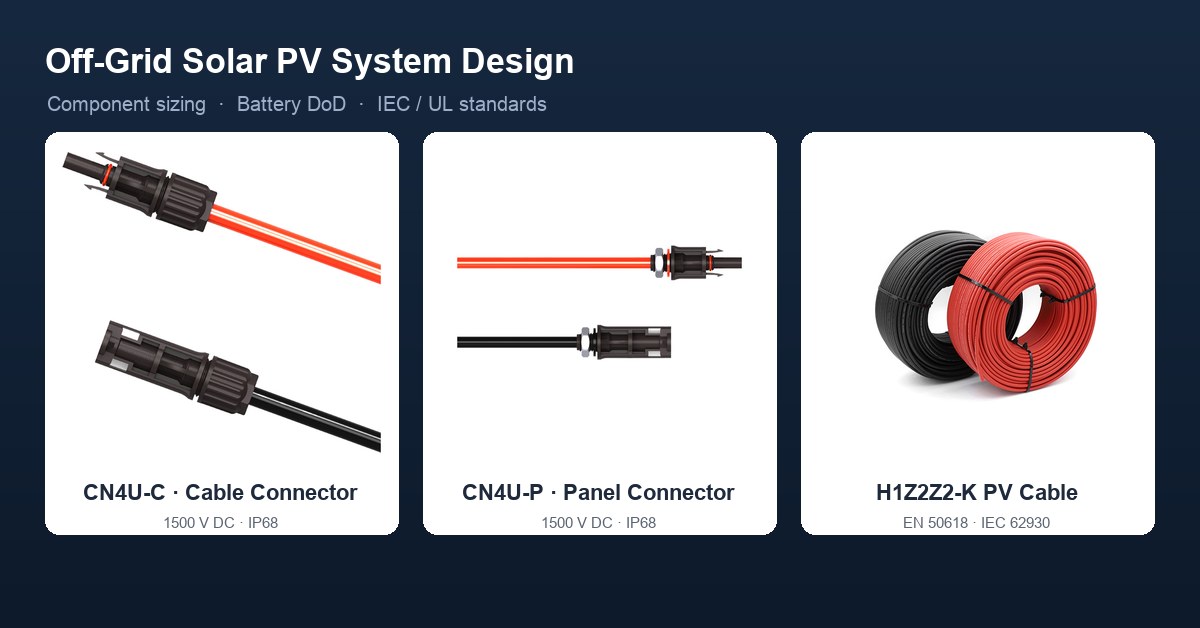
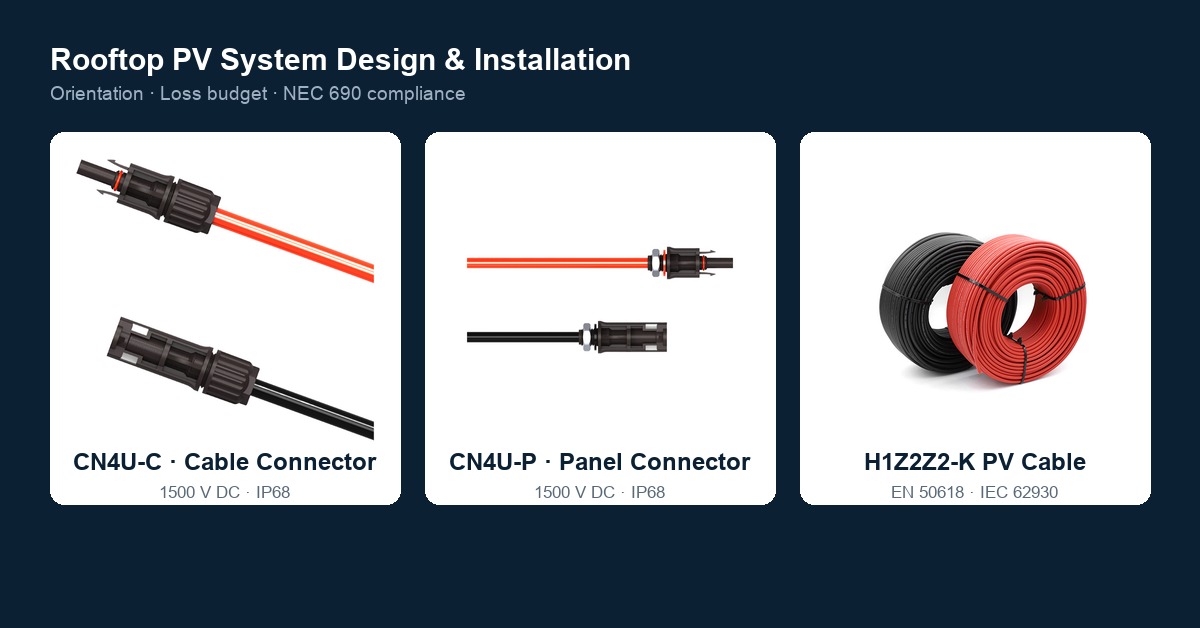
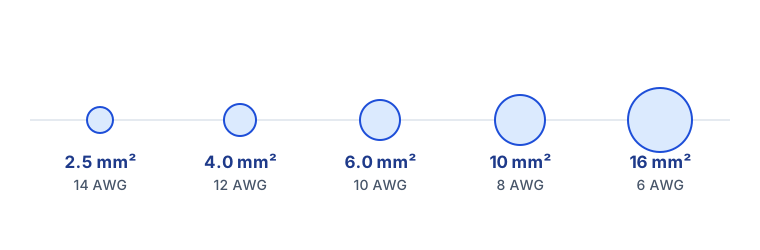
A crimping tool is only as useful as the conductor window it can form correctly. That window is set by the connectors the tool serves. Treasol's CN4U series defines it precisely:
| Connector | Conductor cross-section | AWG |
|---|---|---|
| CN4U-C cable connector | 2.5 / 4.0 / 6.0 / 10 / 16 mm² | 14 / 12 / 10 / 8 / 6 |
| CN4U-P panel connector | 2.5 / 4.0 / 6.0 mm² | 14 / 12 / 10 |
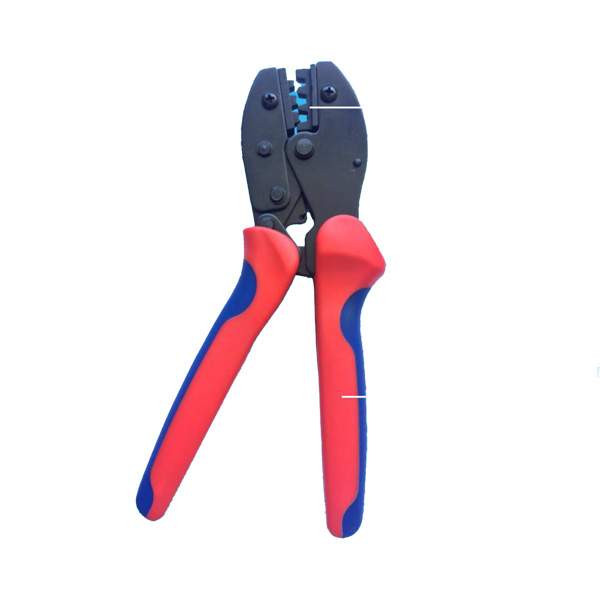
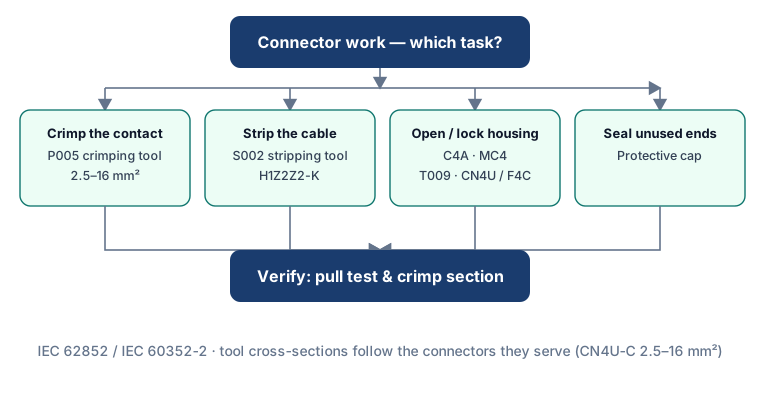
The CN4U-C accepts conductors from 2.5 mm² (14 AWG) up to 16 mm² (6 AWG), while the CN4U-P spans 2.5 mm² to 6.0 mm² (14–10 AWG). The P005 crimping tool is the tool matched to that range: it must form a correct crimp across the full 2.5–16 mm² window so the same tool works whether you are terminating a thin 4 mm² string lead or a 16 mm² homerun cable.
Stripping the H1Z2Z2-K cable cleanly
Before any crimp there is a strip, and the strip has its own failure mode. The H1Z2Z2-K solar cable (rated under EN 50618) is built from fine, flexible copper strands. If the stripping tool nicks even a few strands, the effective cross-section drops and the joint's resistance rises — the same thermal failure the crimp is supposed to prevent. A clean strip leaves every strand intact and the insulation edge square, so the crimp barrel grips copper, not plastic.
The S002 stripping tool is matched to the H1Z2Z2-K cable family used across the CN4U connector range. Stripping by hand with a knife is the most common cause of nicked strands in the field, and no pull test can repair a strand that was already cut before the crimp was made.

Opening and locking housings: T009 and the C4A wrench
Crimping and stripping prepare the cable; the last step is assembling the housing. Two wrenches cover the Treasol range. The T009 tool opens and locks the CN4U cable and panel connectors as well as the F4C fuse connectors — the same connector families the F4C fuse line belongs to. The C4A wrench is matched to the C4A connector.
Using the right wrench matters more than it looks. A housing forced open with pliers or a screwdriver damages the latch or the sealing groove, and a connector whose latch no longer snaps home can back out of its mate under thermal cycling — exactly the kind of field failure that a correct tool prevents for free.

Verifying the crimp: pull test and cross-section
A good crimp is verified, not assumed. Two checks catch nearly every bad termination. First, the pull test: after crimping, the conductor must not pull out of the terminal under tensile load — the acceptance method is defined in IEC 60352-2, the standard for solderless crimped connections, and the finished connector must also pass the pull and retention tests of IEC 62852, the safety standard for PV DC connectors. Second, the cross-section check: cut one sample crimp and inspect the cut face. The strands should be packed into a solid mass with no voids and no broken strands, and the barrel should be closed symmetrically around the conductor.
Spare cable ends and unmated connectors should not be left open. A protective cap seals the face of an unmated connector against moisture and dirt between installation and commissioning. For the full sequence from cable to commissioning, see our PV cable installation guide.
Frequently asked questions
What crimp range do I need for Treasol CN4U connectors?
Match the tool to the connector's conductor window. The CN4U-C accepts 2.5–16 mm² (14–6 AWG) and the CN4U-P accepts 2.5–6.0 mm² (14–10 AWG). The P005 crimping tool is matched to that range, so one tool covers everything from a 4 mm² string lead to a 16 mm² homerun cable.
Can I strip solar cable with a knife instead of a stripping tool?
You can, but it is the most common way to nick strands in the field. A nicked strand lowers the effective cross-section and raises joint resistance, which turns into heat under DC current. The S002 stripping tool is matched to the H1Z2Z2-K cable family and gives a clean, square strip with every strand intact.
How do I verify that a crimp is good?
Run a pull test — the conductor must not pull out of the terminal — and cut one sample crimp to inspect the cross-section for voids or broken strands. The pull-test method follows IEC 60352-2 for crimped connections, and the finished connector must pass the retention tests of IEC 62852.
Which wrench opens which Treasol connector?
The T009 tool opens and locks the CN4U cable and panel connectors and the F4C fuse connectors. The C4A wrench is matched to the C4A connector. Using the right tool protects the latch and sealing groove, so the housing snaps home correctly and stays mated through thermal cycling.
Every tool above is listed together in the tools & accessories range, or reach out through the contact page with your connector model and conductor size and we will match the right crimp, strip, and assembly tools to your line.