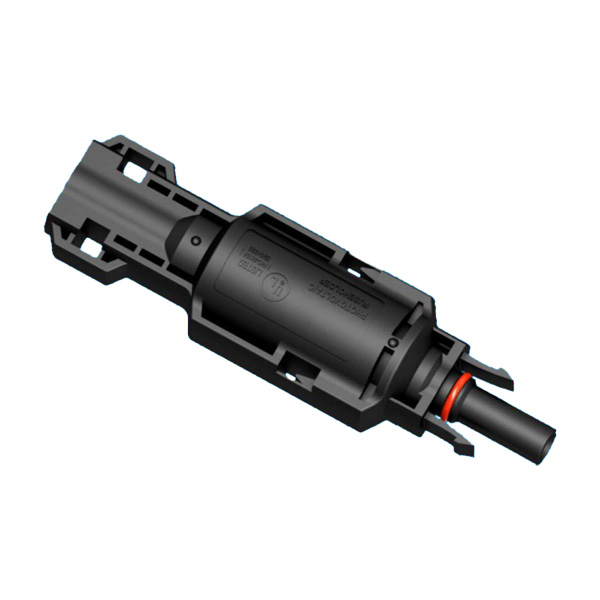
D4A PV Diode Connector
PV Diode ConnectorD4A is a PV diode connector designed for photovoltaic applications, with a 1–8A rated current, 1000 ...
View Details
Last updated: October 2026
Solar connectors with integrated bypass diodes that prevent reverse current flow and hot-spot damage caused by partial shading on photovoltaic panels.
A diode connector packages a diode in the same sealed housing as a PV connector, so reverse-current blocking or bypass protection can be added in line rather than in a separate enclosure. This is used where strings are paralleled at different orientations, or where a blocking diode is needed to stop reverse current flowing into a shaded or faulted string.
D4A is rated 1000 V TÜV / 600 V UL with 1 to 8 A diodes and IP68 protection; D4B is rated 1500 V at 30 A with IP67 protection for higher-current outdoor use. Both use an Ø4 mm pin and the standard PV mating interface.
Showing 2 products in this category
D4A is a PV diode connector designed for photovoltaic applications, with a 1–8A rated current, 1000 ...
View Details
D4B is a 1500 V PV diode connector designed for photovoltaic applications, with a rated current of 3...
View Details| Model | Rated voltage | Rated current | Protection | Contact resistance | Conductor size |
|---|---|---|---|---|---|
| D4A PV Diode Connector | 1000 V (TUV) 600 V (UL) | 1-8 A | IP 68 | <0.5 mΩ | — |
| D4B PV Diode Connector | 1500 V | 30 A | IP 67 | <0.5 mΩ | — |
Values are the mated-pair ratings from our published datasheets. Where a field is blank, that variant does not specify it — ask us and we will confirm against the drawing for your configuration.
A bypass diode sits in parallel with a group of cells and provides an alternate path for current when those cells are shaded, limiting hot-spot heating. A blocking diode sits in series with a string and prevents current from flowing backwards into it. They solve different problems and are placed differently in the circuit — do not substitute one for the other.
Yes, a conducting diode has a forward voltage drop, typically in the 0.4 to 0.7 V range depending on current and temperature. In a blocking-diode application that drop is present continuously, so it has to be counted in the string voltage budget. In bypass operation it only appears, briefly, when the diode conducts.
It matters where strings of different orientation, technology or shading profile are paralleled on the same MPPT input, because the weaker string can be driven into reverse current by the stronger one. Where strings are identical and equally oriented, the blocking diode is usually unnecessary — check the inverter manufacturer's guidance before adding it.