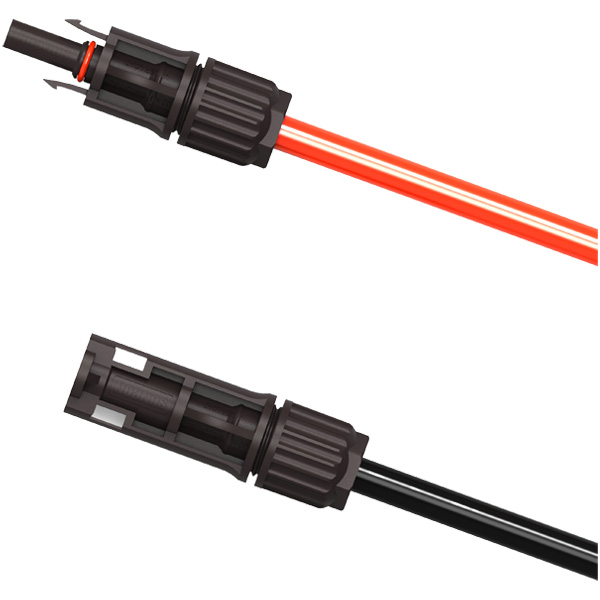
CN4U-C Solar Cable Connector
Solar Cable connectorCN4U-C is a high-current solar cable connector designed for reliable photovoltaic (PV) system connec...
View Details
Last updated: October 2026
MC4-compatible in-line cable connectors for joining and extending solar DC cables between photovoltaic panels, combiner boxes and inverters.
The cable connector terminates the field cable — the conductor is crimped into the contact, the contact is pushed into the housing until it locks, and the gland nut compresses the seal around the insulation. It is the same mating interface as the module connector, used on the other end of the run to join cable to cable, cable to combiner box, and cable to inverter.
CN4U-C accepts 2.5 to 16 mm² (14 to 6 AWG) tinned copper cable, is rated 1500 V DC and up to 70 A, and holds IP68 in the mated condition with contact resistance below 0.5 mΩ. Housing material is PPE/PA66 with UV and anti-ageing stabilisers, rated for -40 °C to +85 °C ambient.
Showing 1 product in this category
| Model | Rated voltage | Rated current | Protection | Contact resistance | Conductor size |
|---|---|---|---|---|---|
| CN4U-C Solar Cable Connector | 1500 V (TUV) 1500 V (UL) | 70 A Max | IP 68 | <0.5 mΩ | 14/12/10/8/6AWG 2.5/4.0/6.0/10/16 mm² |
Values are the mated-pair ratings from our published datasheets. Where a field is blank, that variant does not specify it — ask us and we will confirm against the drawing for your configuration.
CN4U-C covers 2.5, 4, 6, 10 and 16 mm², which correspond to 14, 12, 10, 8 and 6 AWG. The conductor must be stranded (class 5) PV cable and the crimp die has to match the actual conductor size — a mismatched die is the most common cause of a high-resistance joint.
Yes. The contact requires a full-section crimp made with the correct die; plier-style or universal crimps do not produce a gas-tight joint and will measure high on contact resistance. Our crimping tool and stripping tool are matched to the CN4U contact geometry.
The housing and gland nut can be unscrewed and the connector unmated, but the crimped contact is a permanent joint — once crimped it should not be re-crimped onto a different conductor. Use the C4A wrench to release a mated pair rather than pulling on the cable.