
A solar cable harness is specified against two things at once: the cable and connector standards of the market where it will be installed, and the documents that prove a given production lot meets them. Unit price is the third variable, and it carries meaning only once the first two are fixed. In Europe the working pair is EN 50618:2014 and IEC/EN 62852:2015; in North America it is UL 4703 PV Wire with UL 6703 and NEC Article 690; in China it is NB/T 42073-2016 with the CQC certification rules. Two dates change what a tender may claim: TÜV Rheinland withdrew 2PfG 1169 and 2PfG 1990 on 27 October 2017, and GB/T 48188.1/.2-2026, published on 28 September 2026, does not take effect until 1 April 2027. The sections below mark where a cost saving becomes a change of approval route, list the ten documents to request before releasing a purchase order, and set out how to read a capacity claim. [R1][R9][R14]
Key points
- IEC 62930:2017, clause 5.1.1, requires copper conductors with tinned wires. An aluminium substitution is not a specification change within that standard; it is a different product under a different approval route. [R1]
- TÜV Rheinland withdrew 2PfG 1169 and 2PfG 1990 on 27 October 2017. Cables holding only those certificates can no longer be installed in PV systems. [R2]
- IEC 62548:2016 (7.3.9) and IEC 60364-7-712:2017 (712.526) require mated plugs and sockets to be of the same type from the same manufacturer. [R9]
- IP68 is a continuous-immersion designation whose depth and duration are declared by the manufacturer, not fixed by IEC 60529. Ask for the test conditions, not just the two digits. [R11]
- The US DOE Q1 2024 benchmark separates hardware from fieldwork and other soft costs, which is why a harness unit price is a poor proxy for installed cost. [R14]
Standards that apply in the destination market
Start from the destination market, not from the supplier's catalogue. Cable standards and connector standards are separate documents, and a harness must satisfy both.
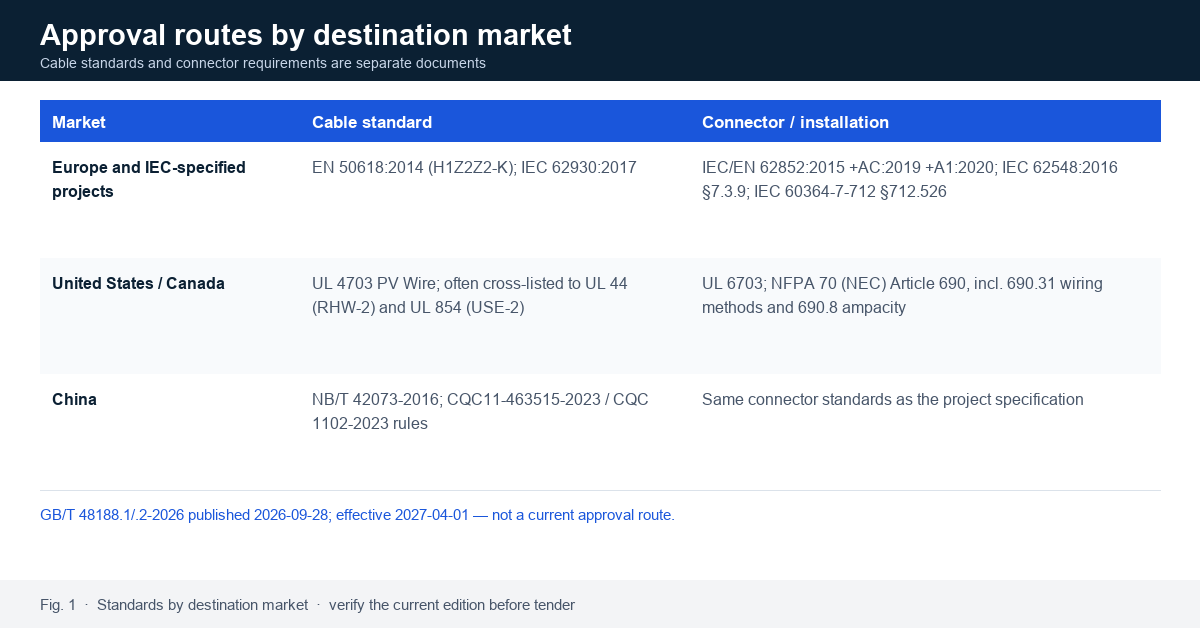
| Market | Cable standard | Connector / installation requirement | Practical notes |
|---|---|---|---|
| Europe, and projects specified to IEC | EN 50618:2014 (H1Z2Z2-K) and IEC 62930:2017 | IEC/EN 62852:2015 (+AC:2019, +A1:2020); IEC 62548:2016 §7.3.9; IEC 60364-7-712:2017 §712.526 | 1.5 kV DC, Class 5 tinned copper, cross-linked halogen-free insulation and sheath [R1][R4] |
| United States / Canada | UL 4703 PV Wire, often cross-listed to UL 44 (RHW-2) and UL 854 (USE-2) | UL 6703; NFPA 70 (NEC) Article 690, including 690.31 wiring methods and 690.8 ampacity | 600 / 1000 / 2000 V ratings; sunlight-resistant, wet/dry 90 °C constructions [R6] |
| China | NB/T 42073-2016, with CQC11-463515-2023 / CQC 1102-2023 certification rules | Same connector standards as the project specification | Since 1 February 2024, copper-conductor PV cable may be certified by CQC against EN 50618:2014; aluminium-alloy conductor cable uses CQC 1102-2023 and/or T/CPIA 0054-2023 [R5] |
Two dates matter here. EN 50618 has been in use since December 2014; TÜV Rheinland withdrew its earlier 2PfG 1169 and 2PfG 1990 specifications on 27 October 2017, and IEC 61730 requires PV module cables to conform to EN 50618. Existing certificates had to be transferred to EN 50618 or IEC 62930. [R2] If a quotation still cites PV1-F against 2PfG 1169 as the only approval, treat it as a documentation gap. Cable construction and conductor class are set out in the Solar PV Cable (H1Z2Z2-K) specification.
For China, check the calendar as well as the number. GB/T 48188.1-2026 (copper conductor, identical to IEC 62930:2017) and GB/T 48188.2-2026 (aluminium alloy conductor) were published on 28 September 2026 but only take effect on 1 April 2027. Until then, NB/T 42073-2016 and the CQC rules remain the working basis. [R8] A tender written today should not describe GB/T 48188 as an applicable current standard.
On connectors, EN 62852:2015 replaced EN 50521:2008. IEC 62852 covers DC connectors for class II equipment up to 1500 V DC and 125 A per contact. [R10] A connector certificate covers a defined product family and a defined mating partner; it is not a generic approval for whatever the harness is plugged into. [R9] The MC4-compatible solar connector specifications give the mating interface and rated values for one such family.
Where cost engineering stops
The most common cost proposal on a DC harness is to change the conductor. Under IEC 62930:2017, clause 5.1.1, "the conductors shall be copper" and the wires shall be tin coated; directly connected cables use Class 5 conductors per IEC 60228. EN 50618 constructions use the same flexible tinned copper. [R1][R4] Switching to aluminium is therefore not a like-for-like substitution on an EN/IEC-certified harness.
That does not mean aluminium has no legitimate route. Some UL 4703 PV Wire products are listed with AA-8000 series aluminium conductors, but this has to be confirmed on the specific UL listing, including terminations and ampacity. [R6] In China, T/CPIA 0054-2023 covers flexible aluminium-alloy PV cable, and GB/T 48188.2-2026 will provide a national standard from April 2027. [R5][R8] Fix the approval route first, then discuss conductor material. Any material change after type approval triggers a re-assessment, not a price negotiation.
Conductor cross-section is a second place where savings are often overstated. A DC voltage-drop target of 2% or less is normal design practice for PV source and output circuits. The NEC figures of 3% for a branch circuit or feeder and 5% combined appear in an Informational Note to 210.19(A) and are explanatory material under NEC 90.5, not a mandatory limit. Before reducing 6 mm² to 4 mm², the conductor still has to satisfy the 125% Isc ampacity calculation in NEC 690.8, ambient temperature correction, overcurrent protection coordination and the connector's rated current. [R6] Voltage drop is one constraint among several.
Insulation and sheath compounds are a third. IEC 62930 specifies a cross-linked compound for both layers and sets minimum thicknesses. [R1] "LSZH" describes low-smoke, zero-halogen performance (IEC 60754 / IEC 61034 test methods), while XLPE and XLPO name material families; they are not alternative drop-in options. [R4] Reducing sheath wall thickness below the specified minimum, or changing compound supplier without a change-control record, removes the basis on which the type test was issued. H1Z2Z2-K cable construction is a useful reference for what a construction sheet should state.
Connectors, branch points and the mismatch problem
IEC 62548:2016, clause 7.3.9, states that plugs and socket connectors mated together in a PV system shall be of the same type from the same manufacturer. IEC 60364-7-712:2017, clause 712.526, says the same for male and female connectors. [R9] Stäubli's public position goes further: it recognises no third-party product as compatible with the Original MC4 portfolio and states that certification is tied to one manufacturer's product family. [R9] MC4 and MC4-Evo 2 are Stäubli trademarks; this article uses "MC4-style" only as a descriptive reference to the common interface.

Field evidence points in the same direction. IEA PVPS Task 13 publishes failure fact sheets covering connector and cable defects, [R13] and the fire-safety literature summarised by Fronius (drawing on Sepanski et al. 2015 and BRE work) lists poorly crimped contacts, moisture ingress, incompatible mating and incompletely engaged connectors among the causes of DC series arcs. [R15] These are installation and process failures as much as product failures, which is why a factory-terminated PV wiring harness assembly is worth specifying with its process records, not only its part number.
A workable drawing and purchase order should state the following:
- Name the connector manufacturer and exact model on the drawing and purchase order, for both harness ends.
- Keep both mating halves within one product family and one manufacturer for the whole string, including extension leads and combiner-box tails.
- Require the matching crimp tool and applicator to be identified in the work instruction; a ratcheting tool alone does not prove crimp quality.
- Ask for crimp-height records, pull-force results and micro-section evidence against IPC/WHMA-A-620. [R12]
IP ratings need the same treatment. Under IEC 60529, the first digit 6 is dust-tight; the second digit 8 covers continuous immersion under conditions more severe than IPX7, with the depth and duration declared for the product. [R11] An "IP68" label without a stated depth, duration, sample configuration and mating state is not a comparable specification. Overmoulding a T- or Y-branch is a sound manufacturing method, but the moulding process is not itself a certification — request the environmental and ageing test report for the finished branch assembly. PV connector manufacturing and process controls describes the inspection gates that sit behind those records.
The document pack to request before releasing a PO
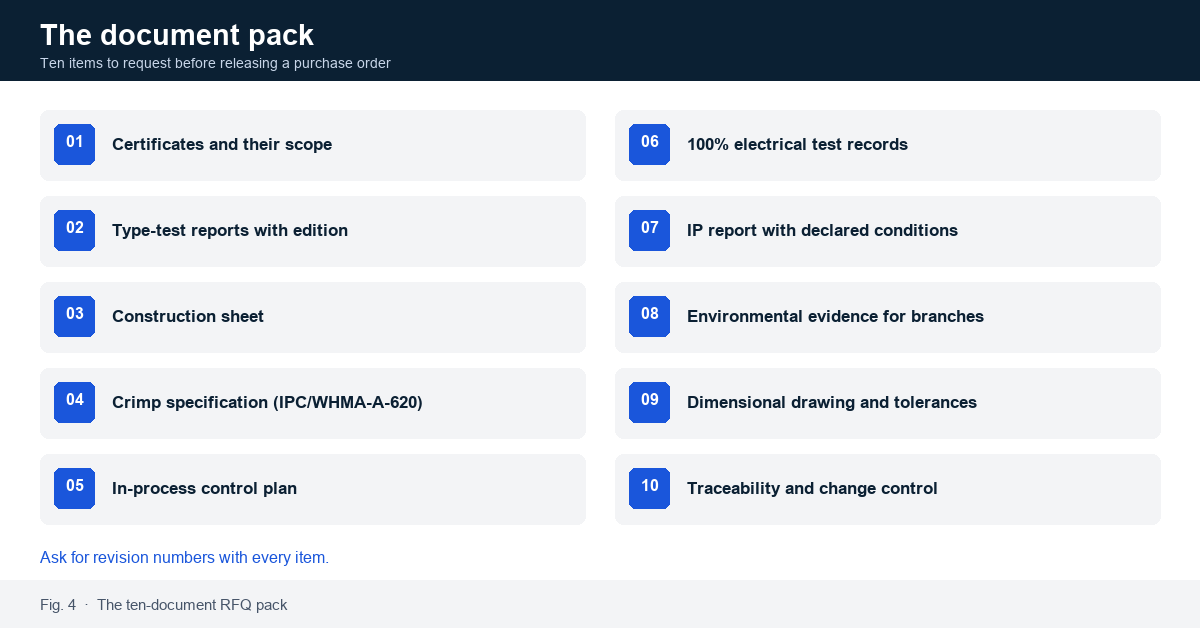
Ten items turn a quotation into a verifiable specification. Ask for them as a package, with revision numbers.

- Certificates and their scope, for the cable (EN 50618 / IEC 62930 / UL 4703 / CQC) and separately for the connector (IEC 62852 / UL 6703). Model designations on the certificate must match the drawing.
- Type-test reports, including the standard edition and amendment they were issued against.
- Construction sheet: conductor class and tinning, cross-section, insulation and sheath compound, nominal and minimum wall thickness, rated voltage and temperature range.
- Crimp specification: terminal part number, crimp height and width window, die/applicator ID, minimum pull-force per conductor size, and micro-section records. IPC/WHMA-A-620 is the consensus acceptance standard for harness assemblies. [R12]
- In-process control plan: crimp-force monitoring, first-article approval, and the frequency of periodic pull tests and cross-sections.
- 100% electrical test records: point-to-point continuity, dielectric withstand voltage and duration, insulation resistance where specified.
- IP test report with declared depth, duration, sample configuration and whether the connector was in the mated state. [R11]
- Environmental evidence for overmoulded branches: UV, ozone, thermal cycling and, for coastal or agrivoltaic sites, salt mist or ammonia exposure as applicable to the project specification.
- Dimensional drawing: cut lengths, breakout positions, tolerances, and the method used to verify length; state the installation allowance policy explicitly.
- Traceability and change control: lot coding, cable metre marking and date code, plus written notification before any material, tooling or process change.
Reading an installed-cost quote rather than a unit price
The US Department of Energy's Q1 2024 solar cost benchmark reports a modelled market price of $3.15/Wdc for an 8 kWdc residential system and $1.12/Wdc for a 100 MWdc utility system (2023 US dollars). Its PV System Cost Model separates eight categories: module, inverter, storage, structural BOS and electrical BOS are hardware; fieldwork, office work and other developer costs are soft costs. [R14] A harness sits inside electrical BOS. A saving of a few cents per metre does not offset a rework visit, a failed inspection or a string taken offline.
Moving cutting, stripping, crimping and overmoulding into a controlled production line removes variables that are hard to manage on a roof or in a field. That is a sound engineering argument on its own; it does not need an unsupported percentage. If a supplier quotes a fixed figure for on-site labour savings, ask for the project sample, the measurement method and the baseline it was measured against.
Topology changes are the lower-risk savings: a trunk-and-drop layout instead of running every string back to the combiner, lengths set from the module and racking layout rather than a generous allowance, and reusable reels or logistics boxes instead of single-use packaging. The branch connector series covers the 2-to-1 through 6-to-1 options used in such layouts. Each of these changes the drawing, so each should pass through the same change-control step as a material change.
Lead time: capacity evidence and a rolling plan
Lead-time claims are only as good as the bottleneck calculation behind them. For cable, ask for the number of extrusion lines and their line speed. For harness assembly, ask for the automatic cut/strip/crimp machines, injection moulding machines and the mould tool IDs for the branch design. Request a monthly capacity sheet that shows the bottleneck operation rather than a headline number.
Be precise about shifts. A two-shift pattern is typically around 16 hours, not 24; if a supplier quotes 24-hour coverage, ask whether that means three shifts, overtime, or a separate weekend arrangement. For raw material, confirm the supply arrangement for copper rod and XLPO compound and whether the connector programme has a defined safety stock. [R5][R4]
A rolling plan has three windows: a 3–6 month forecast for material preparation and copper price hedging, a 1–2 month window for production slot allocation, and a formal purchase order in the current month. Capacity can be reserved before peak season, but any specification change — even a small one — should be re-confirmed against the certificate scope and the tooling before that reserved slot is used. Vendor-managed inventory works best for standardised connectors and common 4 mm² / 6 mm² cable, with the stock level agreed per programme rather than set by a generic number of weeks. Manufacturing capacity and process records are the documents to ask for when validating a lead-time claim.
RFQ checklist
| Item | Ask for | Reference | Red flag |
|---|---|---|---|
| Approval basis | Standard + edition + certificate number, cable and connector separately | [R1][R10] | Only "TÜV certified" with no standard or scope |
| Conductor | Class, tinning, cross-section, compound, minimum wall thickness | [R1][R4] | Aluminium offered against an EN/IEC copper approval |
| Mating | Manufacturer and model on both ends; same-family pairing statement | [R9] | "MC4 compatible with all brands" |
| Crimp | Height window, pull-force, micro-section, CFM records | [R12] | Visual inspection offered as the only control |
| Sealing | IP report with depth, duration, mated state | [R11] | "IP68" with no test conditions |
| Electrical test | 100% continuity + hipot, with voltage and duration | [R12][R13] | Sample-only electrical testing |
| Traceability | Lot code, date code, change notification | [R5] | No written change-control process |
| Capacity | Bottleneck calculation, shift pattern, tooling IDs | [R14] | A single monthly figure with no basis |
The product catalogue lists the connector, branch, cable and harness families that these questions apply to.
FAQ
Can an aluminium-conductor PV cable be used on an EN 50618 or IEC 62930 project?
Not as a substitution. IEC 62930:2017 clause 5.1.1 requires copper with tinned wires. Aluminium conductors exist under other approval routes — specific UL 4703 listings, China's T/CPIA 0054-2023, and GB/T 48188.2-2026 from 1 April 2027 — but switching material changes the product and its certification basis. [R1][R5][R6][R8]
Is a 2% voltage drop a code requirement?
No. NEC 210.19(A) Informational Note No. 4 gives 3% for a branch circuit or feeder and 5% combined as explanatory guidance, and Informational Notes are not enforceable requirements under NEC 90.5. In PV DC design, 2% or less is the customary efficiency target, but ampacity under 690.8 and temperature correction set the minimum conductor size first. [R6]
Can a harness connector be mated with a different brand of module connector?
Installation standards say no. IEC 62548:2016 §7.3.9 and IEC 60364-7-712:2017 §712.526 require the same type from the same manufacturer, and connector certification is issued for a product family with its own mating parts. [R9]
What does an IP68 rating actually tell me?
That the enclosure is dust-tight and was tested for continuous immersion under conditions declared by the manufacturer, more severe than the IPX7 temporary-immersion test. Ask for the depth, duration, report number and whether the sample was mated. [R11]
Which certificates should be in the quotation?
Two sets: one for the cable (EN 50618 / IEC 62930 / UL 4703 / CQC as applicable) and one for the connector (IEC 62852 / UL 6703), each with model numbers that match the drawing. [R1][R10][R5]
How should two harness quotations be compared?
Normalise them to the same standard, cross-section, connector model, length tolerance and document pack, then compare installed cost — including rework, inspection and downtime exposure — rather than per-metre price. DOE's benchmark model treats fieldwork and other soft costs separately from hardware for exactly this reason. [R14]
Sources and review note
This article cites standards and official publications available at the time of writing. Standard editions and certification rules change; verify the current edition and the certificate scope before issuing a tender.
References
- IEC 62930:2017, Electric cables for photovoltaic systems with a voltage rating of 1,5 kV DC — standards.iteh.ai preview
- TÜV Rheinland, New International Requirements for Manufacturers of PV cables (2017) — tuv.com
- Eland Cables, H1Z2Z2-K / EN 50618 technical datasheet — elandcables.com
- CQC, 关于新能源电力设备用特种电缆安全认证实施要求修订的通知 (2024-01-29) — cqc.com.cn; CQC11-463515-2023 规则 — PDF
- Encore Wire, PV Wire / USE-2 / RHH / RHW-2 engineering specifications (UL 44, UL 854, UL 4703) — PDF
- 全国标准信息公共服务平台, GB/T 48188.1-2026 与 GB/T 48188.2-2026 — sacinfo.org.cn; samr.gov.cn
- Stäubli, Why cross-connections put your PV project at risk — staubli.com; Safety Risk of mating PV Connectors from different Manufacturers (2020-11-12) — PDF
- NEN, EN/IEC 62852:2015 — nen.nl; Genorma, EN 62852:2015 — genorma.com
- IEC, Ingress protection (IP) ratings guide — iec.ch
- WHMA / IPC, IPC/WHMA-A-620 Requirements and Acceptance for Cable and Wire Harness Assemblies — whma.org
- IEA PVPS Task 13, Quantification of Technical Risks in PV Power Systems, T13-23:2021 — PDF
- U.S. DOE / SETO, Solar Photovoltaic System Cost Benchmarks (Q1 2024) — energy.gov
- Fronius, Fire Safety of PV Systems – Insights and Recommendations — PDF
MC4 and MC4-Evo 2 are trademarks of Stäubli Electrical Connectors AG. Reference is descriptive only and does not imply endorsement, certification or compatibility.
For drawing review, certification scope confirmation or a harness sample built to a defined standard, contact carroll.xue@treasol.com.


