Ask an installer which part of a PV module quietly does its most important work and the answer is rarely the glass or the frame. It is the bypass diode in the junction box — the small semiconductor that keeps a single shaded cell from turning into a hot spot. When it works, the module simply keeps producing. When it fails, one soiled or shaded cell can overheat until the module is destroyed.
This guide covers the two diode connectors Treasol builds — the D4A and the D4B — and the three decisions that determine which one to specify: the diode current, the voltage class, and the enclosure. Every figure below is taken from the D4A and D4B datasheets, so the values you read here are the same values printed on the product pages.
What a bypass diode does in a PV module
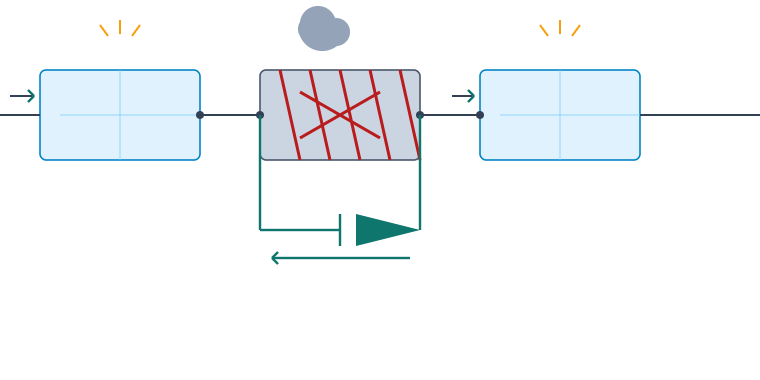
A PV module is a series string of cells. When every cell receives the same light, the whole string carries one current. When a single cell is shaded, soiled, or damaged, it can no longer produce that current — but the series current still has to pass through it. In forward bias the shaded cell becomes a load; if the reverse voltage across it rises to its breakdown point, the cell dissipates power as heat. That is the hot-spot effect, and it is the reason bypass diodes are standard in virtually every modern module.
A bypass diode is wired anti-parallel across a substring of cells. In normal operation it is reverse-biased and conducts nothing. When a cell in that substring becomes a load, the diode turns forward-biased and gives the string current an alternative path around the shaded substring. The module keeps producing from the remaining substrings instead of dumping that energy into the shaded cells as heat.
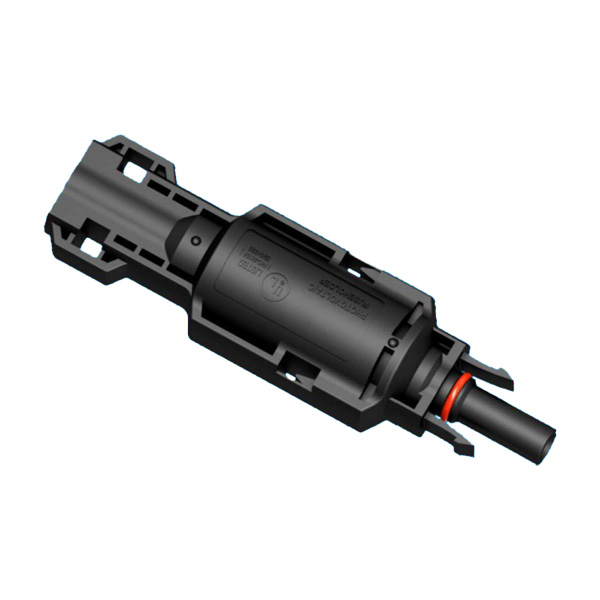
The diode itself sits inside the module or its junction box; the diode connector is the field-terminated link in that protected path. Its current and voltage ratings have to match the module's electrical design — which is where the D4A and the D4B split.
D4A vs D4B at a glance
Treasol builds two diode connector models, and they are not two sizes of the same part. The D4A is a compact connector for lower-current diode circuits; the D4B is the higher-current, higher-voltage variant with a metal-backed enclosure.
| Specification | D4A | D4B |
|---|---|---|
| Rated current | 1–8 A | 30 A |
| Rated voltage (TUV) | 1000 V | 1500 V |
| Rated voltage (UL) | 600 V | — |
| Test voltage | 8 kV (TUV, 50 Hz, 1 min) | 2.5 kV (50 Hz, 1 min) |
| Contact resistance | <0.5 mΩ | <0.5 mΩ |
| Ingress protection | IP68 | IP67 |
| Insulation material | PPE | Aluminum + PPO |
| Contact material | Copper, tin plated | Copper, tin plated |
| Ambient temperature | −40 to +85 °C | −40 to +85 °C |
| Flame class | UL 94-V0 | UL 94-V0 |
| Safety class | II | II |
| Pin dimensions | Ø4 mm | Ø4 mm |
The two models share the same Ø4 mm pin, the same tin-plated copper contact, and the same UL 94-V0 flame class, so the choice between them is about current, voltage, and enclosure — not basic compatibility. Both the D4A and the D4B sit in the PV diode connector range.
Current rating: 1–8 A vs 30 A
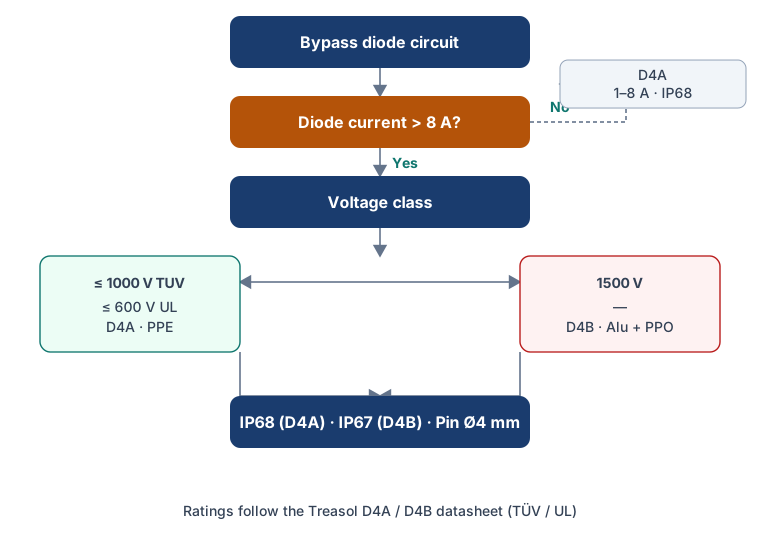
The D4A carries 1 A to 8 A. That is the right envelope for the diode circuits of most standard modules, where each bypass diode handles the current of a single substring. The D4B is rated 30 A — the choice for higher-current designs, larger substrings, or applications where one diode connector has to carry the combined current of a larger group.
The rule is the same as for any series protection: the connector's current rating must be at least the diode circuit current it will actually carry, and the diode's own rating must match the module's design. A diode connector does not set the protection level — it has to carry it without becoming the weak point.
Voltage rating: 1000 V vs 1500 V
Here is where the two models separate most cleanly. The D4A is rated 1000 V under TUV and 600 V under UL. The D4B carries a single 1500 V rating. If you are wiring a North American project, the UL number is the one the inspector checks — and for the D4A that number is 600 V, not 1000 V.
Read both figures together. A connector sold as a "1000 V diode connector" can be a 600 V part in front of a North American inspector. Match the connector's voltage rating to the system voltage first, and only then look at current.
Enclosure: PPE vs Aluminum+PPO, IP68 vs IP67
The enclosure is the difference most buyers feel but never read. The D4A uses a PPE (polyphenylene ether) housing and is sealed to IP68. The D4B adds an aluminum shell around a PPO (polyphenylene oxide) body and is sealed to IP67.
If the connector sits inside a junction box that is already sealed, the D4B's IP67 is more than enough. If it is exposed on a cable run, the D4A's IP68 is the safer call — provided its 8 A ceiling is enough for the circuit. For the failure mechanisms that make this choice matter, see our article on why poor connector quality causes solar fires, and for how these parts are verified see PV connector testing.

Frequently asked questions
Why does a PV module need a bypass diode?
A bypass diode protects the module from the hot-spot effect. When one cell is shaded or damaged, it stops producing while the series current still has to flow; without a bypass diode the cell can overheat and destroy the module. The diode gives the string current an alternative path around the shaded substring, so the rest of the module keeps producing safely.
What is the difference between the D4A and the D4B diode connector?
The D4A is rated 1–8 A with a 1000 V TUV / 600 V UL rating, a PPE housing, and IP68 sealing. The D4B is rated 30 A with a 1500 V rating, an aluminum-plus-PPO housing, and IP67 sealing. Both share a Ø4 mm pin, tin-plated copper contacts, and a UL 94-V0 flame class.
Can a 1500 V diode connector be used in a 1000 V system?
Yes. A connector rated for a higher voltage may be usable at a lower voltage, but only within its certification scope, cable compatibility, and the applicable design and installation conditions. The reverse is not true — a 600 V UL rated connector must not be used on a higher-voltage circuit. Using the higher-rated part costs a little more but is electrically safe.
What current rating should my diode connector have?
Match it to the diode circuit it will carry. The D4A covers 1–8 A, which suits the single-substring bypass diodes of most standard modules; the D4B covers 30 A for higher-current designs. The connector must carry the circuit's diode current without becoming the weakest point, and the diode itself must match the module's electrical design.
Not sure which model fits your module design? The full PV diode connector range lists the D4A and D4B side by side, or reach out through the contact page with your module's diode current and system voltage and we will match the right model.